- Home
- Guides & resources
- Quality & inspections
- In-factory inspections: PPI, DUPRO, PSI and loading check
In-factory inspections: PPI, DUPRO, PSI and loading check
Pre-production, during production, final, loading: what each inspection checks, when to book it, how to read the AQL report and accept or reject a batch.
Contents12 items
- The four inspections at a glance
- Before production: the pre-production inspection (PPI)
- During production: the during-production inspection (DUPRO)
- Before shipment: the pre-shipment inspection (PSI)
- At the factory: container loading supervision (CLS)
- The complements: factory audit and laboratory testing
- When to book what: building your inspection plan
- What a good inspection report contains
- Accepting or rejecting a batch: how to decide
- At NOVASEA: the report in Bridge within 24 hours
- Frequently asked questions
- Sources
An in-factory inspection lets you decide on facts while you still have leverage over the supplier. Once the container is at sea and the balance is paid, a defect is settled through a claim or a sort on arrival, usually at your expense.
Their English acronyms are the industry standard, in Europe, the UK and North America alike, with variations from one provider to another. Here is what each inspection checks, when to book it and how to decide.
The four inspections at a glance
| Inspection | Timing | Question asked | What you do with it |
|---|---|---|---|
| PPI, pre-production | Before production starts, up to ~20% of products | Are materials and components compliant? | Green light or correction before the run |
| DUPRO, during production | ~20 to 50% of products (sometimes from 10-15%) | Is a defect recurring? | Correct it while there is still time |
| PSI, final | 100% produced, at least 80% packed | Is the batch compliant? | Accept or reject, then pay the balance |
| CLS, loading | While the container is being loaded | Is the inspected batch the one shipping? | Evidence in case of a dispute |
Before production: the pre-production inspection (PPI)
The pre-production inspection (Pre-Production Inspection, PPI) takes place before the production run starts or at its very beginning. Some providers call it Initial Production Check (IPC) and carry it out up to around 20% of the order produced, so that the first pieces are examined too.
The inspector checks in particular:
- materials and components in stock: references, quantities, storage;
- compliance with the approved and sealed reference sample (golden sample): color, material, dimensions;
- printed elements: logo, labels, instructions, spelling;
- line organization and the announced schedule.
When to book it? For a first order, a critical material (fabric, electronic component, food-contact plastic) or a key component bought by the factory itself. It is the best time to spot a silent substitution: a cheaper component fitted without warning.
During production: the during-production inspection (DUPRO)
The during-production inspection (During Production Inspection, DUPRO, sometimes shortened to DPI) takes place when part of the order has come off the line. Depending on the provider, it starts from 10 to 15% or from 20% produced, and at the latest at the halfway point. In practice, the useful window runs from about 20 to 50%.
Below that, too few pieces are made to spot a recurring defect. Beyond that, most of the run is manufactured: a defect found at 70% means sorting or reworking thousands of pieces, with a high risk of delay. The inspector measures actual progress, checks a randomly drawn sample and traces recurring defects back to their cause (machine setting, workstation, material).
Before shipment: the pre-shipment inspection (PSI)
The pre-shipment inspection (Pre-Shipment Inspection, PSI), also called Final Random Inspection (FRI), is the most common and the most decisive: it grounds your decision to accept the batch and pay the balance.
The 80% packed rule
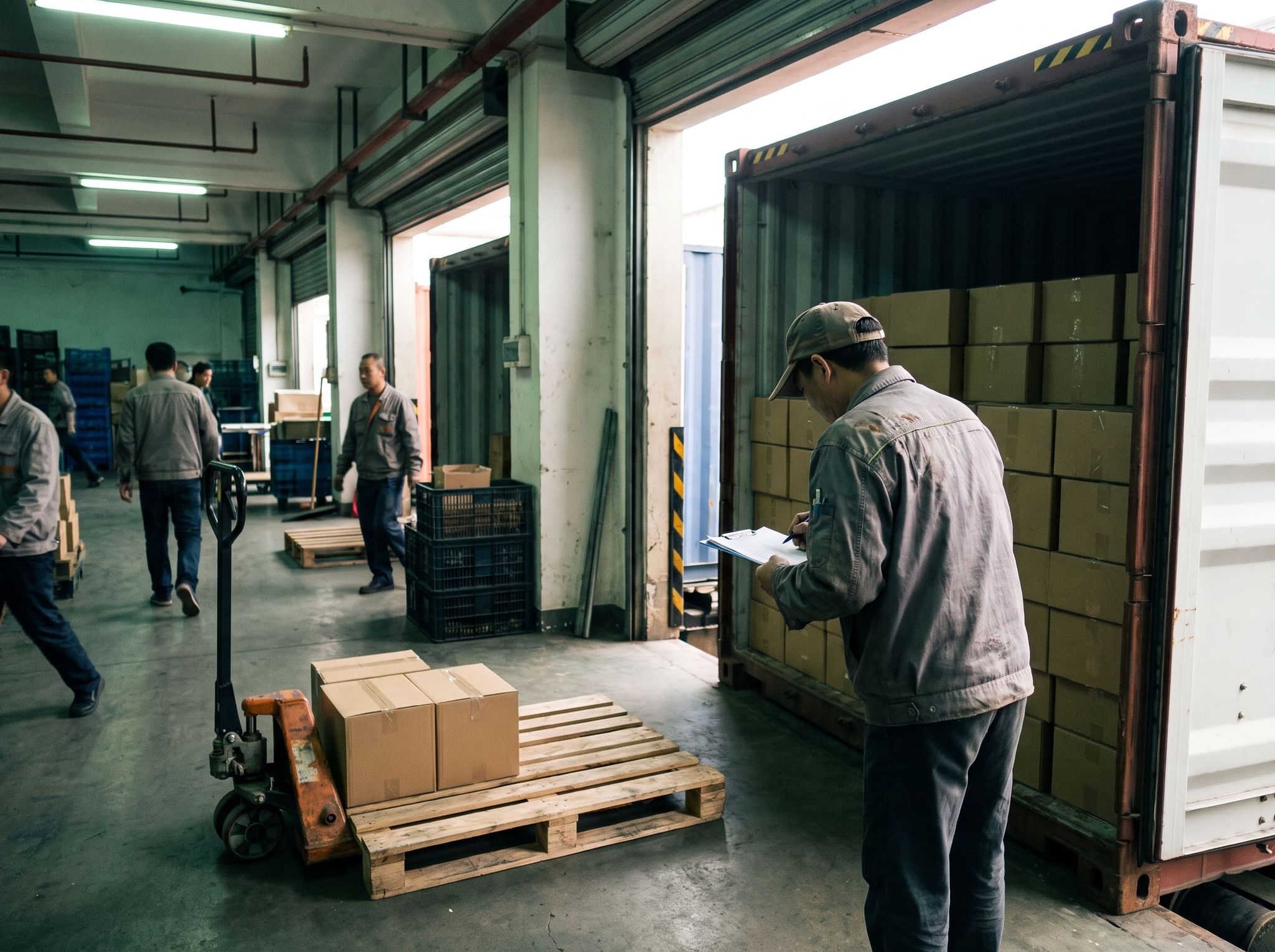
The most widespread rule: production 100% complete and at least 80% of the products packed in their export cartons. Two reasons for this:
- Representativeness: the sample is drawn from the whole batch. At 30% packed, the inspector only sees the first runs, not those produced in the rush of the final week.
- The actual packaging: cartons, markings and labels can only be checked on finished packages.
Some providers step in from 80% of the order produced, if packing has started: that is a compromise, which leaves the end of production unchecked.
The inspector chooses the cartons himself, from the whole stock. A widespread rule of thumb, which is not a standard, is to open a number close to the square root of the total, rounded up: 23 cartons for 500.
What the pre-shipment inspection checks
| Checkpoint | Examples of checks |
|---|---|
| Quantities | Pieces produced and packed, number of cartons |
| Compliance | Color, model, logo, labels vs golden sample |
| Workmanship | Appearance, assembly and finishing defects |
| Measurements | Dimensions and weight vs tolerances |
| On-site tests | Function, assembly, barcodes, carton drop test |
| Packaging | Retail unit, cartons, shipping markings |
The sample size and tolerated defects come from AQL sampling, under the international standard ISO 2859-1 or its US counterpart ANSI/ASQ Z1.4 (American National Standards Institute / American Society for Quality). Defects are critical (danger, regulatory non-compliance), major (unsellable product or one that does not perform its function) or minor (a deviation with no effect on use), each class with its own tolerance.
At the factory: container loading supervision (CLS)
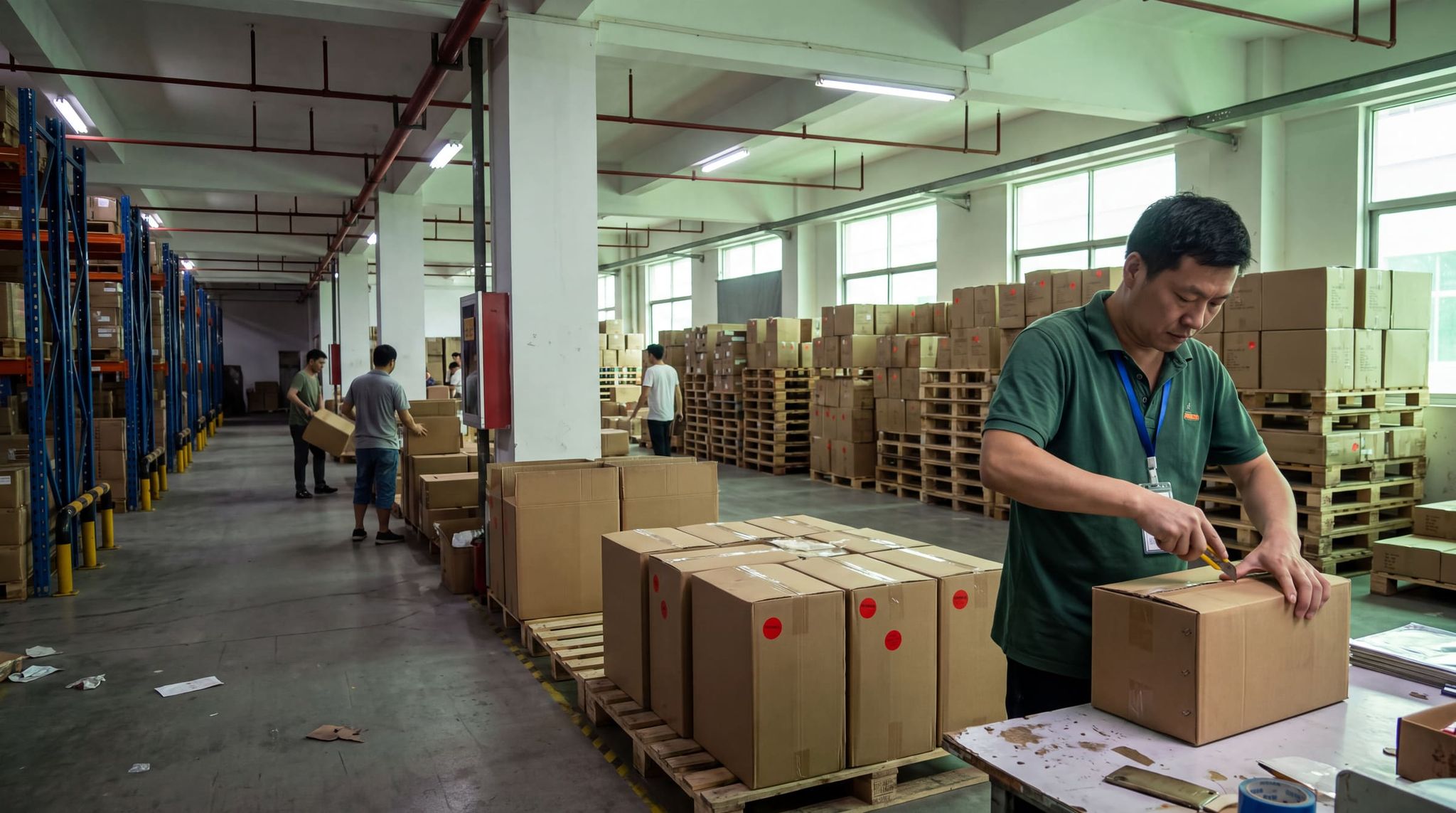
Container loading supervision (CLS, also called CLC, CLI or LS) takes place during stuffing, that is, the loading of the container. It verifies that the batch inspected, complete and in good condition, is the one that ships. The inspector:
- examines the empty container: walls, floor, doors and seals; no holes, no moisture, no odor;
- counts the cartons and reconciles them against the packing list;
- opens a few cartons at random: right products, right quantities, right labels;
- watches the loading: stacking (how cartons are piled), bracing (blocking so they do not move), damaged cartons set aside;
- witnesses the seal being applied and photographs its number.
ISO 17712 classifies seals into three levels: I (indicative), S (security) and H (high security). For shipments by members of the US Customs CTPAT program (Customs Trade Partnership Against Terrorism), CBP (U.S. Customs and Border Protection) requires the shipper, or the stuffer acting on its behalf, to apply a high-security seal compliant with the current version of ISO 17712 as soon as loading is complete.
The program also requires the so-called VVTT check: examine the seal and the door locks, match its number against the shipping documents, pull on it, then turn it to make sure nothing is unscrewing. Even outside CTPAT, ask your inspector to run this routine.
This check makes the most sense when several suppliers share a container, as in a multi-supplier consolidation. Inspection bodies remind us: it does not replace the pre-shipment inspection.
The complements: factory audit and laboratory testing
Inspections assess a batch. Two other checks answer different questions.
| Check | What it assesses | When |
|---|---|---|
| Factory audit | The supplier: capabilities, quality, social conditions | Before the 1st order, then periodically |
| Laboratory test | Composition, safety, strength | Before market launch, then at every change |
| Inspection | A specific batch, on a sample | At every order |
The factory audit verifies that the factory actually makes what it sells and can sustain quality and volumes. Social audits follow recognized frameworks such as Sedex SMETA or amfori BSCI, where a single report serves several buyers. Detailed method in our guide to vetting a Chinese supplier and on our factory audits page.
Laboratory tests measure what an inspector cannot see: a heavy metal in paint, the fire resistance of a fabric. Choose an ISO/IEC 17025-accredited laboratory where possible, the competence standard for testing laboratories. Some markets require them, each with its own rules.
In the United States, a children's product subject to a CPSC (Consumer Product Safety Commission) safety rule must be tested, before import, by a CPSC-accepted third-party laboratory. On that basis, the importer (treated as the manufacturer for a product made abroad) issues the Children's Product Certificate (CPC): if you import, that is your responsibility, not the factory's.
Tests are repeated periodically and at every significant change in design or process. Since July 8, 2026, importers of most regulated products must also transmit their certificates electronically to CBP at customs clearance (eFiling).
In Canada, the Canada Consumer Product Safety Act prohibits manufacturing, importing or selling a product that presents an unreasonable danger; manufacturers and importers must keep certain documents and provide Health Canada, on request, with the studies or tests supporting the product's safety.
In Europe and the UK, testing depends on the legislation applicable to the product: see our guide on product compliance in the EU and the UK.
When to book what: building your inspection plan
Nothing requires all four inspections on every order: the plan depends on risk.
| Situation | Recommended checks |
|---|---|
| New supplier, 1st order | Audit, PPI, DUPRO, PSI |
| Proven supplier, identical reorder | PSI, CLS if needed |
| Regulated product (children's, electrical) | Laboratory tests, PPI, PSI |
| Large volume or firm delivery date | DUPRO in addition to PSI |
| Several suppliers, one container | One PSI per supplier, then CLS |
On timing, allow generally a few business days between booking and the visit. Book as soon as the factory announces its production end date, and have it confirm 48 hours beforehand that 80% will be packed: a wasted visit can be billed to you and costs you days.
What a good inspection report contains
The major inspection bodies deliver their report the same day or within 24 hours. A usable report includes:
- Identification: purchase order, product (SKU), factory, date, inspector.
- The verdict on the first page: pass, fail, or pending when an issue requires your decision.
- The AQL table: batch size, inspection level, sample size and, for each defect class, the acceptance number (Ac, maximum allowed), rejection number (Re, rejection threshold) and the number found.
- Defects classified, with one photo per defect.
- Measurements: specified value, tolerance, measured value.
- On-site tests, overview photos (stock, cartons, markings, comparison with the golden sample) and verified quantities.
Three concepts are all you need to read an AQL table. The standard assigns each batch size a code letter, which sets the number of units to draw. General inspection level II is the default unless stated otherwise. Normal inspection is the starting regime, which the standard allows you to tighten (tightened) or relax (reduced) based on the supplier's history.
The calculator below runs this calculation for any batch size and any AQL.
Accepting or rejecting a batch: how to decide
The AQL verdict is a statistical threshold, not an automatic sentence: read the nature of the defects as much as their number.
- Accept: the batch passes; you authorize shipment and payment of the balance.
- Accept with reservations: a threshold is only slightly exceeded, on minor defects with no consequence for your customer, in exchange for a discount or a written commitment to correct.
- Reject: the factory sorts, reworks or replaces, then a new inspection takes place. With zero tolerance, a single critical defect is enough to reject.
The supplier contract is worth spelling out who pays for the reinspection and for delays in the event of a rejection: without a clause, every rejection becomes a negotiation.
At NOVASEA: the report in Bridge within 24 hours
Our inspectors carry out the four inspections, tracked in NOVASEA Bridge, the client portal. An inspection can be booked in 24 hours and appears in Bridge as soon as it is scheduled. After the visit, our quality manager validates the report, published within 24 hours: photos, measurements compared against the specification, tests, classified defects, AQL table, verdict and PDF.
For the pre-shipment inspection, the batch leaves the factory only with your approval, given online by the authorized roles in your organization (account manager, buyer, quality). A rejection must be justified; your project manager relays it to the factory within the hour. Details of our services on our quality control page.
Frequently asked questions
Do you need to carry out all four inspections on every order?
No. The pre-shipment inspection is the minimum for any significant order; the others are added depending on risk. A reorder from a proven supplier often needs only a pre-shipment inspection.
Who pays for the inspection, and who pays for the reinspection?
Generally, the buyer orders and pays for the inspection. The reinspection after a rejection can be charged to the supplier if the contract provides for it: negotiate this clause before ordering.
Does an AQL inspection guarantee a defect-free batch?
No. AQL is a sampling plan: it tolerates a limited number of defects and only sees the units drawn. For an essential safety point, add a 100% check or a laboratory test.
What is the difference from the "pre-shipment inspection" required by some countries?
Some importing governments require a pre-shipment inspection to verify the price, quantity and quality of goods, to counter trade fraud, customs evasion or capital flight. Governed by a World Trade Organization (WTO) agreement, it is distinct from the quality inspection you order on your own behalf.
Sources
- Children's Product Certificate (CPC) — U.S. Consumer Product Safety Commission (new tab)
- Certificates of Compliance, final rule (January 8, 2025) — Federal Register / CPSC (new tab)
- 15 U.S. Code § 2063, Product certification and labeling — LII, Cornell (new tab)
- 16 CFR § 1107.1, Purpose (Part 1107, Testing and labeling pertaining to product certification) — LII, Cornell (new tab)
- CTPAT Minimum Security Criteria, U.S. Importers (October 2021) — U.S. Customs and Border Protection (new tab)
- C-TPAT Bulletin: Compliance with ISO's 17712 Standards for High Security Seals (April 2014) — U.S. Customs and Border Protection (new tab)
- Meeting Canada Consumer Product Safety Act requirements — Health Canada (new tab)
- Preshipment inspection — World Trade Organization (new tab)
- SMETA audit — Sedex (new tab)
- amfori BSCI — amfori (new tab)
- Production Inspection Services — Intertek (new tab)
- During Production Inspection (DUPRO) — Intertek (new tab)
- Final Random Inspection (FRI) — Intertek (new tab)
- Initial Production Check (IPC) — QIMA (new tab)
- During Production Inspection (DUPRO) — QIMA (new tab)
- Pre-Shipment Inspection (PSI) — QIMA (new tab)
- Container Loading Check (CLC) — QIMA (new tab)
- Final Random Inspection (FRI) — TESTCOO (new tab)
- What is the AQL (Acceptance Quality Limit)? — QualityInspection.org (new tab)
- How does a random quality inspection work? — QualityInspection.org (new tab)