
- Home
- Guides & resources
- Logistics & freight
- Ocean freight FCL or LCL: containers, lead times, costs and documents
Ocean freight FCL or LCL: containers, lead times, costs and documents
Choosing between FCL and LCL, knowing the real container dimensions, transit times to Europe and North America, surcharges, demurrage, VGM, security declarations and Red Sea routing in 2026.
Contents12 items
- FCL or LCL: two ways to ship by container
- Standard containers: dimensions, volume and payload
- How many cartons and pallets fit in a container?
- FCL or LCL: from what volume does a full container pay off?
- Transit times: Asia → Europe and North America
- Red Sea and Suez Canal: where things stand in September 2026
- The key documents for an ocean shipment
- VGM: the mandatory weighing under the SOLAS convention
- Reading a quote: base freight and surcharges
- Demurrage and detention: the charges that run after arrival
- Frequently asked questions
- Sources
The ocean container is the standard way to import from Asia to Europe, the UK or North America. The principle is simple, but quotes are packed with acronyms and ancillary charges: this guide reviews them, with costed examples. Market data (routings, surcharges) is current as of September 25, 2026.
FCL or LCL: two ways to ship by container
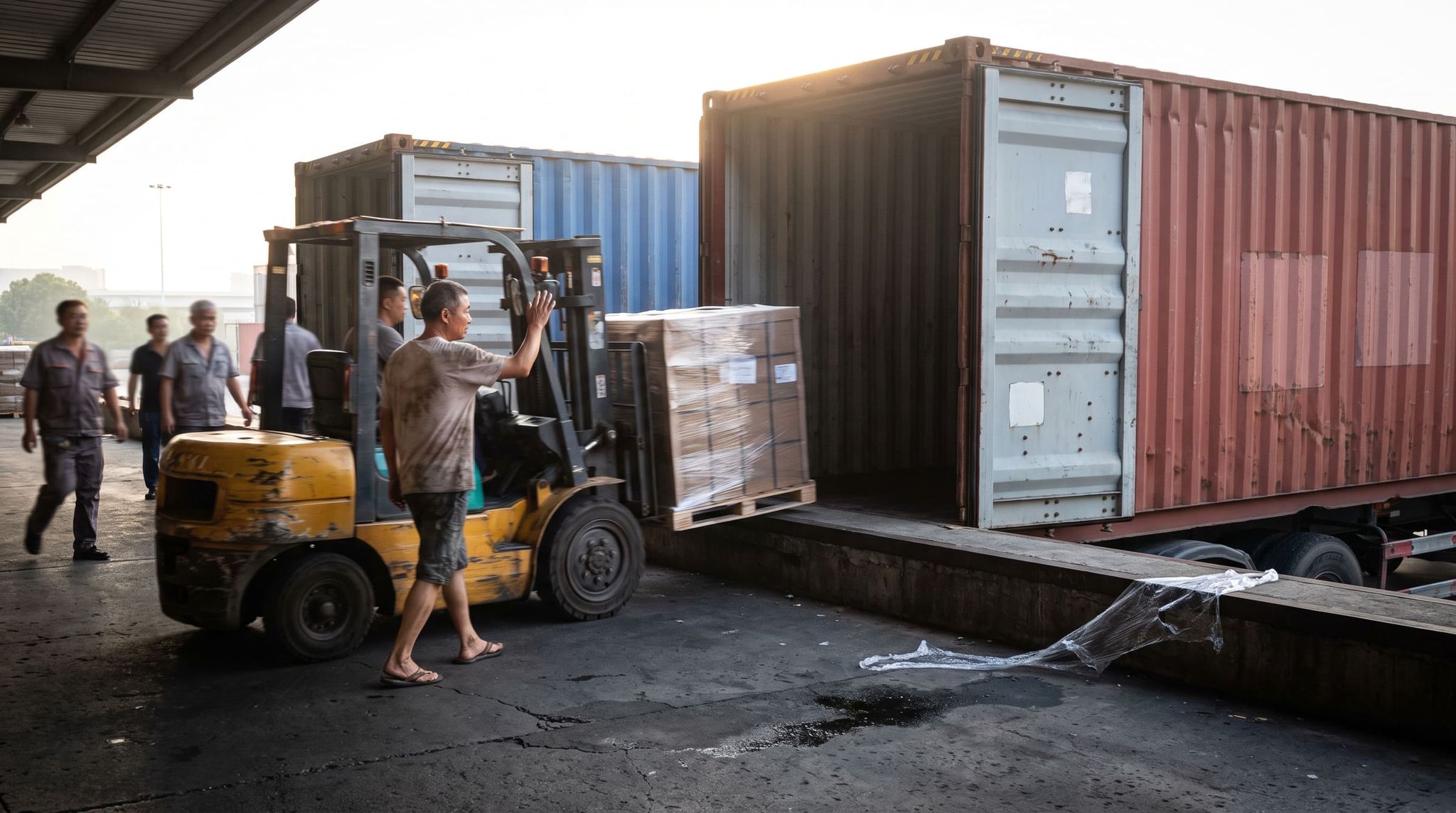
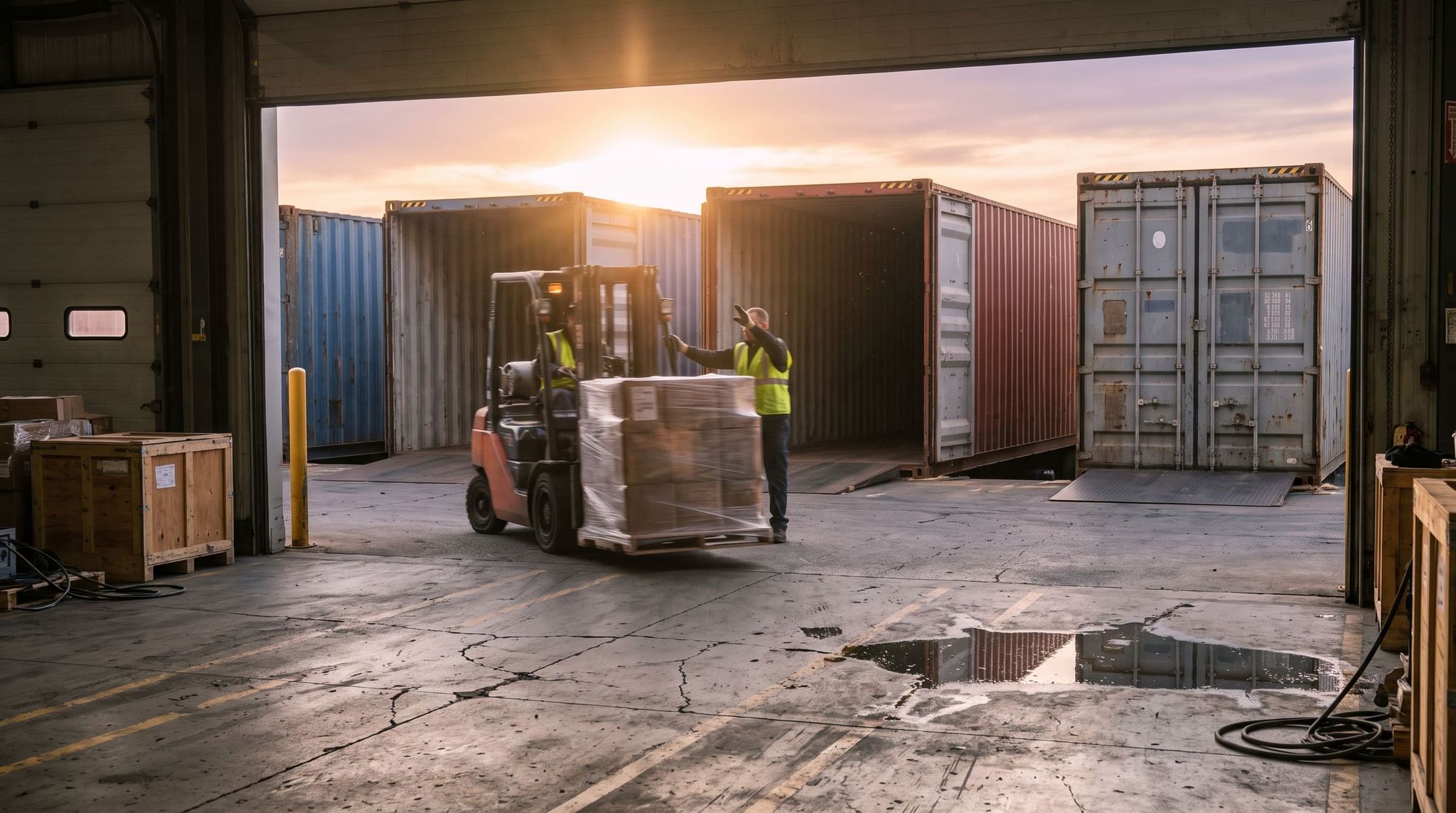
With FCL (Full Container Load), you book a full container. It is loaded ("stuffed") at the supplier or in a warehouse, closed with a numbered seal ("sealed"), then travels closed to destination, unless customs inspects it. Freight is paid per container, full or not.
With LCL (Less than Container Load, groupage), your packages join those of other shippers. A consolidator, often an NVOCC (Non-Vessel Operating Common Carrier), receives them at a container freight station (CFS) and stuffs them. On arrival, it unstuffs (empties) the container and sorts the batches by consignee.
| Criterion | FCL (full container) | LCL (groupage) |
|---|---|---|
| Pricing basis | Flat rate per container | Per m³ or per ton |
| Handling | One stuffing, one unstuffing | Consolidation then deconsolidation |
| Transit time | More direct | Longer |
| Risk of damage or loss | Lower | Higher |
| Best for | Large volumes, fragile goods | Small batches, replenishments, first orders |
If you buy from several suppliers, a third option exists: multi-supplier consolidation, which groups your orders into a single full container at origin, with a single import file.
Standard containers: dimensions, volume and payload
- TEU (Twenty-foot Equivalent Unit): the statistical unit of container shipping, equivalent to a 20-foot ISO container. A 40' counts as 2 TEU.
- CBM (cubic meter): the cubic meter, the billing unit for LCL. A carton of 60 × 40 × 40 cm is 0.096 m³.
- GP (General Purpose): the standard dry container. HC (High Cube): same length and width, but one foot (about 30 cm) more in height.
The first table gives the usable space, the second what the container can carry: the tare is the empty weight, the payload the maximum weight of goods, the gross mass the sum of the two. Maersk values, in millimeters:
| Type | Internal L × W × H | Door W × H | Volume |
|---|---|---|---|
| 20' GP | 5,896 × 2,350 × 2,393 | 2,350 × 2,274 | 33 m³ |
| 40' GP | 12,032 × 2,350 × 2,393 | 2,340 × 2,274 | 67 m³ |
| 40' HC | 12,032 × 2,350 × 2,697 | 2,340 × 2,577 | 76 m³ |
| Type | Tare | Max. payload | Max. gross mass |
|---|---|---|---|
| 20' GP | 2,280 kg | 28,200 kg | 30,480 kg |
| 40' GP | 3,700 kg | 28,800 kg | 32,500 kg |
| 40' HC | 3,880 kg | 28,620 kg | 32,500 kg |
The reefer (refrigerated container) houses its own cooling unit, hence less space: 27 m³ in a 20' and 67.5 m³ in a 40' HC at Maersk. It requires a temperature setting and an electrical connection both ashore and on board.
How many cartons and pallets fit in a container?
On the floor, in a single layer, the published orders of magnitude are:
- 20': about 11 Euro pallets (1,200 × 800 mm) or 9 to 10 US pallets (48 × 40 inches).
- 40' and 40' HC (same floor area): about 23 to 24 Euro pallets, 25 in a very tight layout, or 20 to 21 US pallets.
To stack pallets, the HC makes the difference: two 1.25 m pallets (2.50 m total) clear the 2.58 m door of a 40' HC, but not the 2.27 m door of a 40' GP.
FCL or LCL: from what volume does a full container pay off?
LCL is billed in W/M units (weight or measure): the higher of the volume in m³ and the weight in tons applies. A shipment of 2.5 m³ weighing 700 kg is billed at 2.5 W/M; the same volume weighing 3,200 kg is billed at 3.2 W/M. Fixed charges per shipment (documents, terminal fees) and minimum billing amounts are added on top.
FCL becomes cheaper as soon as the total LCL cost exceeds the all-in flat rate for a container: threshold = (all-in FCL cost − LCL fixed charges) ÷ LCL rate per m³. There is no fixed volume above which FCL always wins; published comparisons cite an average of 13 to 15 m³, less than half a 20'.
At similar volumes, FCL remains preferable for fragile goods (less handling) or urgent shipments. With LCL, a customs inspection targeting the consolidation container can also delay every batch inside it.
Transit times: Asia → Europe and North America
Rough sailing times from Shanghai, varying by route and number of port calls:
| Destination | Route | Rough estimate |
|---|---|---|
| Rotterdam | Suez | 27 to 35 days |
| Rotterdam | Cape of Good Hope | + 10 to 14 days |
| Genoa | Suez | ≈ 22 days at sea |
| Genoa | Cape of Good Hope | + 11 to 13 days |
| Los Angeles / Long Beach | Pacific | ≈ 14 days |
| New York | Panama | ≈ 28 days |
| New York | West Coast then rail | ≈ 14 days + 5 to 8 days by rail |
The 27 days to Rotterdam and 22 days to Genoa assume a nonstop crossing at 16 knots (1 knot = 1 nautical mile per hour, or 1.852 km/h); with 5 to 10 port calls, an Asia–Europe rotation takes closer to 35 days. The Mediterranean is hit hardest by the detour around Africa: via Suez, Genoa is much closer to Shanghai than Rotterdam, but via the Cape the two distances become comparable. For the US East Coast, routing around Africa costs 5 to 10 days more than Suez, depending on estimates.
Via Panama, allow extra margin: the canal again lowered the draft (maximum authorized depth) in its neopanamax locks, the largest ones, on August 26 and September 3, 2026, without reducing the number of daily transits according to its authority. Demand there also surged amid the disruptions around the Strait of Hormuz: in August, waiting times exceeded a week and an auctioned slot reportedly sold for close to USD 4 million. Ask whether your service has reserved slots.
These transit times cover sea only: for door-to-door, add inland transport to the port, cut-off dates, possible rollovers, customs clearance and delivery.

Red Sea and Suez Canal: where things stand in September 2026
Since late 2023, attacks on vessels in the Red Sea and the Bab el-Mandeb Strait have pushed most Asia–Europe services to route around Africa. In 2026, the return to Suez is underway, but partial and reversible:
- Maersk and Hapag-Lloyd (Gemini Cooperation, their alliance) moved AE15 back to Suez in July 2026, then AE19 in August; on September 15, they announced AE11, AE5 and ME2 starting September 19, 21 and 24, with the date for AE12 still to be confirmed. In early September, Maersk noted that this was not yet a general return of its East-West network, while aiming for a full return eventually if security allows.
- MSC has partially resumed Suez since August 20, 2026, service by service (including Jade, Albatros and Tiger to Europe and the Mediterranean); CMA CGM has done so on certain services and COSCO has begun rebuilding its own.
- Across the market, according to Sea-Intelligence, only 13 to 25% of Asia → Europe capacity (headhaul) was passing through the Red Sea in September 2026. The Mediterranean is further along: 57% of Asia–Mediterranean services transiting the Red Sea, versus 27% to Northern Europe, both directions combined.
- The returns remain reversible: on September 10, 2026, Houthi forces took the Yemeni port of Mokha, about 75 km from Bab el-Mandeb, amid escalating tensions between Iran and the United States over Hormuz. Back in January, CMA CGM had already rerouted three services back to the Cape.
- The transition has its pitfalls: in September, Maersk reported persistent congestion in major Northern European and Mediterranean ports, worsened by strikes at German terminals. Allow extra margin on your delivery dates.
The key documents for an ocean shipment
- Booking confirmation: vessel, cut-off dates for container drop-off, documents and VGM.
- Commercial invoice: value, currency, delivery terms, origin; the basis of the customs value.
- Packing list: packages, weights, volumes, markings, consistent with the invoice.
- Bill of Lading (B/L): issued by the carrier, it evidences receipt of the goods and the contract of carriage. The negotiable original represents the goods: whoever holds it can take delivery.
- Product-specific documents: certificate of origin, certificates of conformity, safety data sheets…
The sea waybill (non-negotiable transport document) and the telex release (originals surrendered at origin, delivery released by message) avoid sending the paper original by courier. In LCL, the consolidator issues each customer a "house" B/L and receives a "master" B/L from the shipping line for the whole container.
Destination authorities also require security data before loading:
| Destination | Declaration | Deadline (container) |
|---|---|---|
| European Union | ENS in ICS2 | 24 hours before loading on the vessel entering the EU |
| Great Britain | ENS via S&S GB | 24 hours before loading at the port of departure |
| United States | ISF "10+2" | 24 hours before loading on the vessel |
| Canada | ACI (eManifest) | 24 hours before loading |
The ENS (Entry Summary Declaration) goes through ICS2 (Import Control System 2), in service for maritime traffic since June 3, 2024 (progressive rollout through 2025) in the EU, Northern Ireland, Norway and Switzerland. In case of transshipment, the deadline counts back from loading on the mother vessel. Great Britain has its own system, S&S GB (Safety and Security GB).
Who files? In the EU, Great Britain and Canada, the obligation falls on the carrier, with freight forwarders adding the data for their "house" B/Ls in the EU and Canada. In the United States, the ISF (Importer Security Filing) is the importer's responsibility: the importer provides 10 data elements, usually through its customs broker, and the carrier 2 more, hence the nickname "10+2". A late or inaccurate ISF exposes the importer to penalties. See our guide import customs clearance in the EU, the UK and the United States.
VGM: the mandatory weighing under the SOLAS convention
Since July 1, 2016, the SOLAS convention (Safety of Life at Sea) of the IMO (International Maritime Organization) requires declaring the VGM (Verified Gross Mass) of every packed container, to prevent loading plans skewed by misdeclared weights.
- Who? The shipper named on the bill of lading, who transmits it to the carrier and the terminal before the cut-off.
- Consequence? No VGM, no loading.
- How? Method 1: weigh the packed container. Method 2: weigh packages, pallets and dunnage, then add the tare, using a certified method approved by the state where packing was completed.
In LCL, the consolidator declares the VGM based on the weights you provide: your packing list must be accurate.
Reading a quote: base freight and surcharges
A quote adds up base freight and surcharges, at origin, in transit or at destination:
| Acronym | Meaning | What it covers |
|---|---|---|
| BAF | Bunker Adjustment Factor | Variation in the price of fuel |
| THC | Terminal Handling Charges | Handling at the terminal |
| PSS | Peak Season Surcharge | Peak season |
| WRS | War Risk Surcharge | War risk on certain routes |
| CFS charges | Container Freight Station | Consolidation and deconsolidation in LCL |
At Maersk, the BAF is revised every quarter against a 0.5% sulfur fuel oil index (December 2025 notice). Another example: from June 10, 2026, Maersk applied a PSS of USD 300 per 20' and USD 600 per 40' and 45' from the Far East (excluding South Korea, affected from June 25) to Northern Europe and the Mediterranean. These surcharges change by notice: a quote always has a validity period.
Who pays what depends on the Incoterms® rule chosen (Incoterms® is a registered trademark of the International Chamber of Commerce, ICC). Under FCA (Free Carrier) or FOB (Free On Board), the buyer chooses its freight forwarder and pays the main freight; under CFR (Cost and Freight) or CIF (Cost, Insurance and Freight), the seller books the transport. For containerized goods, handed over at the terminal before being on board, the ICC points to FCA rather than FOB: see FOB, CIF, DDP or EXW: which Incoterm should you choose?
Demurrage and detention: the charges that run after arrival
Each shipping line grants free time, which varies by port and is negotiable at booking. Beyond that, two daily meters start running:
- Demurrage: the full container stays at the terminal after discharge, for lack of pickup (customs clearance blocked, missing document, truck unavailable).
- Detention: the container has left the terminal but is not returned empty on time.
In the United States, the FMC (Federal Maritime Commission, the federal regulator) has required since May 28, 2024 that these charges be invoiced within 30 days of the last day on which they accrued, failing which the customer is not obligated to pay. According to trade press reports, a federal appeals court struck down in September 2025 the provision designating who may be invoiced; the rest of the rule still applies.
Loading plan, weighing, documents, routing monitoring, fast pickup: these checkpoints make for a well-executed logistics service, from the supplier's dock to your warehouse.
Frequently asked questions
What is the difference between a standard 40' and a 40' High Cube?
Same length and width, but one foot taller: about 2.70 m internal height versus 2.39 m, and 76 m³ versus 67 m³ according to Maersk specifications, for a comparable payload. It suits light, bulky cargo.
From how many m³ should you switch to a full container?
There is no universal threshold: comparisons often cite 13 to 15 m³, but only a calculation based on complete quotes is authoritative. At a similar volume, fragility and lead time argue for FCL.
Who pays demurrage and detention?
They are invoiced under the contract of carriage, generally to the importer in an FOB or FCA purchase. Prepare documents and customs clearance before arrival and negotiate free time at booking. In the United States, an invoice issued more than 30 days after the last day of charges does not have to be paid.
Are container ships returning to the Suez Canal?
Partially. Since July 2026, Maersk and Hapag-Lloyd have been gradually moving Asia–Europe services back to Suez, and MSC and CMA CGM some of theirs. But in September, only 13 to 25% of Asia → Europe capacity was using the Red Sea according to Sea-Intelligence, and the seizure of Mokha port is a reminder that these returns are reversible. Check the routing of every booking.
Sources
- Verification of the gross mass of a packed container (SOLAS VI/2, MSC.1/Circ.1475) — International Maritime Organization (new tab)
- Import Control System 2 (ICS2) is live for maritime and inland waterway transport — European Commission (new tab)
- Guidance document on customs formalities on entry and import into the EU (ENS time limits) — European Commission (new tab)
- Safety and security import requirements: entry summary declarations — GOV.UK (HMRC) (new tab)
- Importer Security Filing "10+2" Program, Frequently Asked Questions — U.S. Customs and Border Protection (new tab)
- Memorandum D3-5-1, Marine Pre-load/Pre-arrival and Reporting Requirements — Canada Border Services Agency (new tab)
- Final Rule on Demurrage & Detention Cleared to Take Full Effect May 28 — Federal Maritime Commission (new tab)
- Glossary: Twenty-foot equivalent unit (TEU) — Eurostat (new tab)
- Incoterms® 2020: FCA or FOB? — ICC Academy (new tab)
- Our fleet, equipment specifications: dry containers — Maersk (new tab)
- Our fleet, equipment specifications: reefer containers — Maersk (new tab)
- Bunker Adjustment Factor (BAF), December 2025 — Maersk (new tab)
- Implementation of Peak Season Surcharge (PSS) from Far East Asia to North Europe and Mediterranean — Maersk (new tab)
- Europe Market Update, September 2026 — Maersk (new tab)
- Maersk targets full Suez return as Ocean Q2 earnings rebound — WorldCargo News (new tab)
- MSC partially resumes Suez Canal transits — WorldCargo News (new tab)
- Maersk, Hapag-Lloyd step up Suez routings — WorldCargo News (new tab)
- Houthis seize Mokha port, raising concerns over Red Sea return — WorldCargo News (new tab)
- Red Sea routing normalisation reaches 27% as Suez return builds (Sea-Intelligence data) — Global Maritime Hub (new tab)
- Red Sea doubts resurface as CMA CGM pulls back from Suez route — Global Trade Magazine (new tab)
- Panama Canal cuts Neopanamax draft limits as water levels tighten — WorldCargo News (new tab)
- Panama Canal auction slot reportedly sells for US$4m — WorldCargo News (new tab)
- Routing options between Shanghai, Rotterdam and New York — Port Economics, Management and Policy (new tab)
- Global ocean carriers halt Red Sea transits: what to expect — Flexport (new tab)
- FMC announces demurrage and detention final rule — Holland & Knight (new tab)
- Court partially vacates FMC demurrage & detention rule — Container News (new tab)
- How to calculate ocean freight charges (FCL, LCL, W/M) — iContainers (new tab)
- LCL vs FCL — iContainers (new tab)
- LCL vs FCL: when does a full container save money? — ContainerMath (new tab)
- How many pallets fit in a container — xChange (new tab)