
- Home
- Guides & resources
- Quality & inspections
- How to Order Samples from China and Approve a Golden Sample
How to Order Samples from China and Approve a Golden Sample
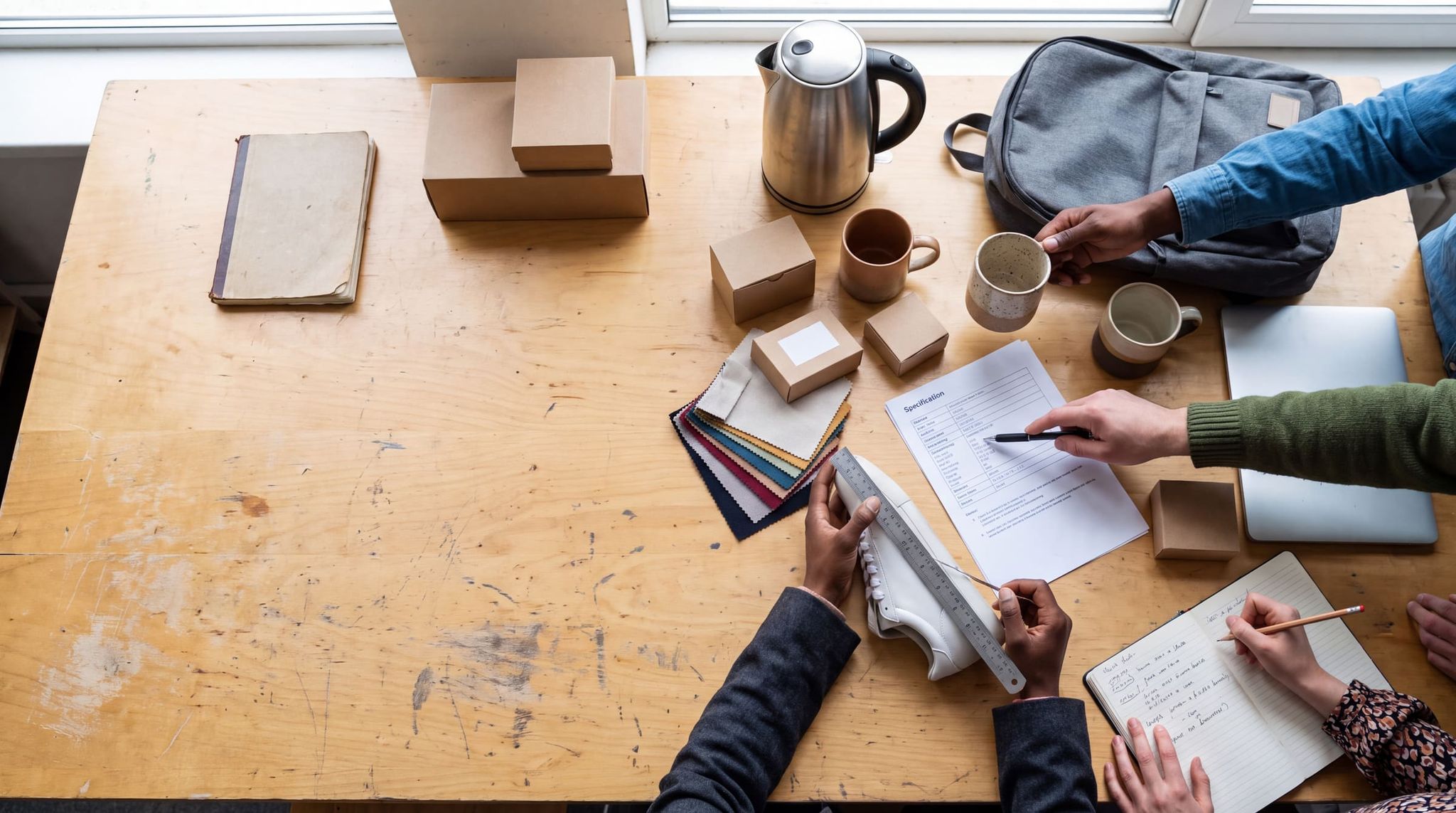
Catalog, custom, pre-production and golden samples: how to order samples from China, clear them through customs, test them against a written checklist and make them the reference for your contract and inspections.
Contents11 items
- The four types of product samples from Chinese suppliers
- How to order samples from China, step by step
- What samples cost, and how to get the fee credited
- Sample lead times: how long it really takes
- Courier shipping and customs for samples: US, UK, EU
- A sample testing checklist that removes guesswork
- Approving and sealing the golden sample
- From golden sample to AQL inspection and contract
- Manage samples yourself or get support on the ground?
- Frequently asked questions
- Sources
A sample is the only physical evidence you get before you wire a deposit to a Chinese supplier. Chosen well, tested properly and approved in writing, it becomes the reference that protects the entire order. Used carelessly, it gives false comfort: a factory can hand-finish one perfect unit, or even buy it from another manufacturer, then ship a production run that looks nothing like it.
This guide explains how to order samples from China, what they cost, how long they take, how they clear customs in the US, the UK and the EU, and how to turn a good sample into a golden sample you can actually enforce in production.
The four types of product samples from Chinese suppliers
| Sample | What it is | What it proves | What it does not prove |
|---|---|---|---|
| Catalog sample | An existing product, pulled from stock or the showroom | The factory's usual level of finish | That it can make your product, or that it made this one itself |
| Custom sample | A unit built to your spec: a prototype, or a copy of a reference you supply | That the factory understood your specification | That it can repeat it at volume |
| Pre-production sample | Made with production materials, tooling and process | That the run will match the sample | Consistency across thousands of units |
| Golden sample | The approved unit, signed, dated and sealed | The reference for production and inspection | Nothing, unless your contract cites it |
Apparel buyers also use a size set (one piece per size) and a top-of-production sample pulled from the start of the run. And at pre-shipment inspection, the inspector draws random units from the finished lot: those units, not the sample you approved months ago, decide whether the order ships.
How to order samples from China, step by step
- Send your specification first, numbered and dated: dimensions and tolerances, materials, finishes, markings, packaging. Without it, you have nothing to hold the sample against.
- Protect your designs before you share them: sign an NNN agreement (non-disclosure, non-use, non-circumvention) and consider filing your trademark in China if you will manufacture there; see how to protect your intellectual property in China.
- Get a written sample quote: price, any tooling, build time, shipping method and refund terms.
- Order from two or three shortlisted suppliers against the same spec, so you compare like with like.
- Pay through a traceable channel, to the legal entity you verified: a platform payment such as Trade Assurance on Alibaba.com, or a bank transfer. Never accept new bank details by email alone.
- Set the shipping rules: which courier and whose account, the real value and a precise description on the invoice, and your full importer details.
- Document the delivery: photos of the box, the unboxing and every piece, before any testing.
What samples cost, and how to get the fee credited
Catalog samples are sometimes free, but you almost always pay the shipping. Custom samples are charged: engineering time, small quantities of material, machine setup. If tooling is involved, a prototype can be 3D-printed or CNC-machined, and the production mold is quoted separately. The most common arrangement is a sample fee credited against your first order: get it in writing, with the conditions (minimum order quantity, how long the credit stays valid).
| Cost item | Who usually pays | What you can negotiate |
|---|---|---|
| Catalog sample | Often free, or billed at unit price | Free samples in exchange for a serious RFQ |
| Custom sample | The buyer | A credit against the first order |
| Prototype, tooling | The buyer | Tool ownership, a credit |
| Express shipping | The buyer, on their courier account or re-billed | Using your own courier account |
| Duties, taxes, brokerage fees | The importer, on arrival | One consolidated shipment from several suppliers |
| Revised versions | Depends on who caused the gap | No charge if the factory caused it |
Sample lead times: how long it really takes
These ranges reflect common practice; confirm them in writing with each supplier.
| Step | Typical timeframe |
|---|---|
| Catalog sample: packing and dispatch | A few days to a week |
| Custom sample, no tooling | One to three weeks |
| Sample requiring a mold or tooling | Four to eight weeks, sometimes more |
| Express from China to the US, the UK or the EU | Roughly three to seven business days, customs included if paperwork is complete |
| Each revised version | One to three more weeks |
| Pre-production sample | Once production materials arrive, just before the run starts |
Plan around Chinese New Year, which falls on February 6, 2027: sample rooms close or slow down for several weeks around that date. Getting a sample approved by mid-January often saves a month; see the timeline of an import from China.
Courier shipping and customs for samples: US, UK, EU
A sample arriving from China is an import like any other. The express carrier (DHL, FedEx, UPS and the like) acts as your customs broker, advances the duties and taxes, then bills you with a processing fee. Two rules apply everywhere: the invoice must show the real value, even if the sample was free, and writing "no commercial value" exempts you from nothing.
- United States: the USD 800 de minimis exemption has been suspended for all countries since August 29, 2025, and for China since May 2025, so samples from China now pay the applicable duties, including the additional tariffs on Chinese-origin goods. Subheading 9811.00.60 lets samples worth USD 1 or less, or samples marked, torn or perforated so they cannot be sold, enter duty-free with a statement on the invoice. It is meant for soliciting orders: samples used for quality control, testing or photography generally do not qualify. Temporary importation under bond (TIB) and ATA carnets exist too, but they also target order solicitation and require re-export or destruction.
- United Kingdom: shipments worth GBP 135 or less still escape customs duty, though not import VAT, and the government has brought forward the end of that relief to October 2028 at the latest. A commercial samples relief exists for items marked or made unusable, in limited quantities, imported to win orders.
- European Union: import VAT has applied from the first euro since July 2021. Since July 1, 2026, the duty exemption for consignments of EUR 150 (≈ $165) or less is gone; for distance sales, a temporary flat duty of EUR 3 (≈ $3.30) per item, counted per tariff classification, applies until July 1, 2028. A narrow relief covers samples of negligible value used only to solicit orders (Regulation (EC) No 1186/2009, Article 86).
For the wider import process, see customs clearance for the EU, the UK and the US.
A sample testing checklist that removes guesswork
Evaluate a sample against your spec, line by line, not by eye. Use the same checklist for every supplier, and grade each gap the way your inspector will later: critical (safety, regulation), major (function, sellable appearance) or minor.
| Criterion | Method | Example requirement |
|---|---|---|
| Dimensions | Tape, calipers, gauge | 10.00 in ± 0.08 in |
| Materials | Material data sheet, test report, simple checks | 304 stainless steel, 6 oz/yd² cotton |
| Color and finish | Compared to the standard under a light booth | Pantone reference, no scratch visible at 3 ft |
| Function | Use test per the manual | Power-on, settings, assembly |
| Durability | Repeated cycles, washes, load | 5,000 open-close cycles, 20 washes |
| Safety and regulations | Lab reports for your market, markings | Applicable US, UK or EU requirements (for example CPSIA testing for children's products, FCC for electronics) |
| Packaging and labeling | Drop test, barcode scan, carton marks | ISTA-type drop test, readable UPC or EAN |
Then send the supplier a numbered sample comments sheet: each gap, with an annotated photo, the expected fix and the next revision of the spec. Translated into Chinese, it keeps version 2 from fixing one defect and creating another.
For regulated products (toys and children's products, electrical goods, food-contact items, cosmetics), run the lab tests on the pre-production sample: that is the unit that represents the production run. Market requirements are covered in our guide to product compliance: CE, UKCA and GPSR.
Approving and sealing the golden sample
The golden sample is the approved reference unit, usually taken from pre-production. It is the yardstick for the factory during the run and for the inspector at the final check.
- Approve in writing: an approval sheet citing the product reference, the spec revision, accepted deviations and points to watch, signed by both parties.
- Make at least two, ideally three: one for you, one for the factory, one for the inspector.
- Seal them: a bag or box closed with a numbered tamper-evident seal, a signed and dated label, photos of every side.
- Control changes: any change of material, sub-supplier or process must be reported to you and trigger a new approved sample.
- Refresh it: golden samples age (colors, elastics, adhesives). Remake them each season or after a long production pause.
From golden sample to AQL inspection and contract
A golden sample only protects you if it is tied to your contract and your inspections. Spell out three links.
- In the contract or purchase order: production must match the specification (revision cited) and the golden sample (seal number); any unapproved deviation is a defect.
- In the inspection criteria: your list of critical, major and minor defects mirrors your testing checklist, and the inspector compares randomly drawn units to the golden sample under ISO 2859-1 (or ANSI/ASQ Z1.4 in the US) at the agreed AQL levels. See our guide to AQL and ISO 2859-1.
- In the payment terms: the balance is paid only after a passing inspection report.
A during-production inspection (DUPRO) checks early that the run follows the golden sample, while fixes are still possible; see PPI, DUPRO, PSI and loading inspections.
Manage samples yourself or get support on the ground?
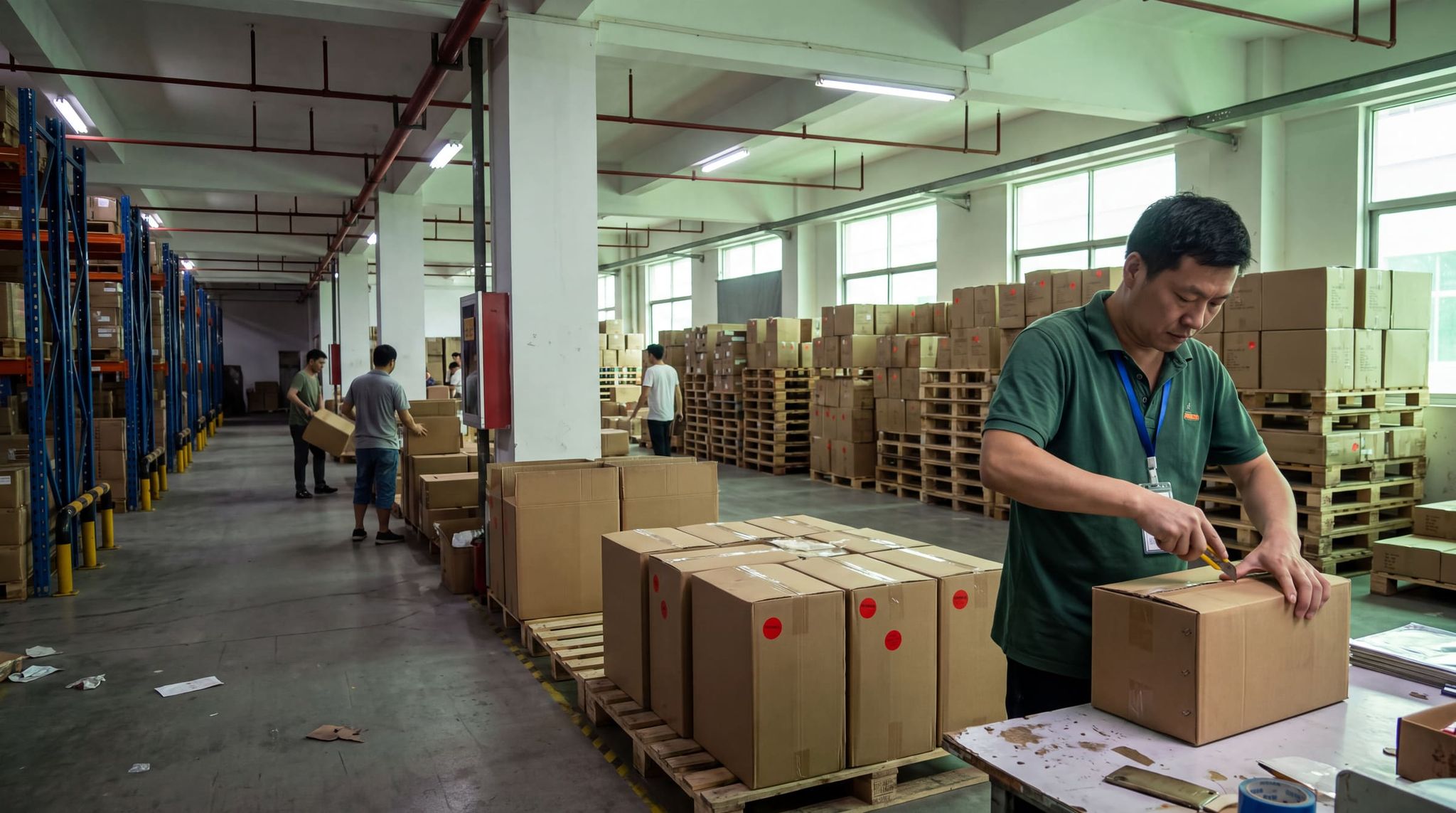
Managing samples yourself is realistic for a simple product, one or two suppliers and a market you know well. It gets harder with scale: several factories, several revisions, lab testing, crossing shipments and technical feedback that has to land in Chinese.
| Step | On your own | With NOVASEA |
|---|---|---|
| Specification | An English spec, interpreted differently by each factory | A bilingual spec, reviewed with the factory's engineers |
| Receiving | One box per supplier, one customs entry each | Shipments coordinated from China, combined when possible |
| Evaluation | A checklist to build, feedback by email | A gap report with photos, discussed in Chinese with the factory |
| Golden sample | Sealed and kept by you alone | Approved, sealed in several copies, used as the reference in our inspections |
| Production | Gaps discovered when the container lands | Inspections with photo reports before the balance is paid |
NOVASEA handles the whole chain: specification, sample coordination, express shipping, gap reports and golden sample approval, followed by quality control inspections with photo reports and consolidation in China, close to your factories. For a new product, our product development team takes the prototype through to the pilot run. Samples, revisions, photos and approvals all live in NOVASEA Bridge: one point of contact, one record. Our fees are on the pricing page.
Frequently asked questions
Are samples from China free?
Rarely, once everything is counted. A catalog sample may be free, but you pay the express shipping and any duties on arrival, and custom samples are charged. Negotiate a written credit of the sample fee against your first order instead.
How long does it take to get a sample from China?
For a catalog sample, a few days to prepare plus three to seven business days by express. For a custom sample, one to three weeks to build, often more than four if tooling is needed. Add one to three weeks for each revision.
What is the difference between a pre-production sample and a golden sample?
A pre-production sample is made with production materials, tooling and process. Once approved, signed and sealed, it becomes the golden sample: the reference for production and inspection.
Do I pay import duties on product samples from China?
Usually, yes. In the US, de minimis is suspended and only samples worth USD 1 or less, or properly mutilated samples used to solicit orders, enter duty-free. In the UK and the EU, import VAT applies, and sample reliefs are narrow.
What if production doesn't match the approved sample?
If the golden sample and your AQL criteria are in the contract, the lot fails inspection: the factory sorts and reworks at its own cost, and a re-inspection takes place before you pay the balance. Without a written reference, you have a disagreement, not a defect.
Sources
- CBP modernizes low-value shipment processing (de minimis suspension) — U.S. Customs and Border Protection, June 24, 2026 (new tab)
- Commercial samples imported into the US, subheading 9811.00.60 — Hong Kong Trade and Industry Department (2006 circular) (new tab)
- Knowing your options when importing commercial samples (9811.00.60, TIB, ATA carnet) — C.H. Robinson (new tab)
- Tax and customs for goods sent from abroad (GBP 135 threshold) — GOV.UK (new tab)
- Reforming customs rules for low value imports — HMRC, GOV.UK, July 2026 (new tab)
- Acceleration of low value import reforms to October 2028 — HM Treasury, GOV.UK, June 23, 2026 (new tab)
- Pay no import duty and VAT on importing commercial samples — GOV.UK (new tab)
- EUR 3 customs duty on low-value parcels from July 1, 2026 — European Commission (new tab)
- Guidance and legal text on the temporary flat fee, applicable until July 1, 2028 — European Commission, DG Taxation and Customs Union (new tab)
- Removal of the EUR 22 import VAT exemption (July 1, 2021) — European Commission, VAT One Stop Shop (new tab)
- Regulation (EC) No 1186/2009 on reliefs from customs duty, Article 86 — EUR-Lex (new tab)
- ISO 2859-1:2026, sampling procedures for inspection by attributes — ISO (new tab)
- Lithium batteries, dangerous goods regulations — IATA (new tab)
- Test procedures — ISTA (new tab)
- 2027 public holidays (Lunar New Year) — GovHK (new tab)